
Licensed and Unlicensed Cultivation Across Ban and Permit Jurisdictions
Project Overview
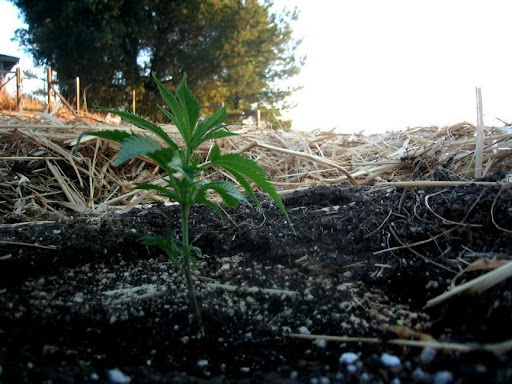
This project aimed to assess unlicensed cannabis production and its spatial distribution over time, to compare these assessments with licensed market development, and to investigate the factors that affect (or do not affect) variation in unlicensed production across space and time.
Findings
Broken out by objectives we have rendered the following:
Provide empirical assessments of California’s unlicensed cultivation amounts and geography over time
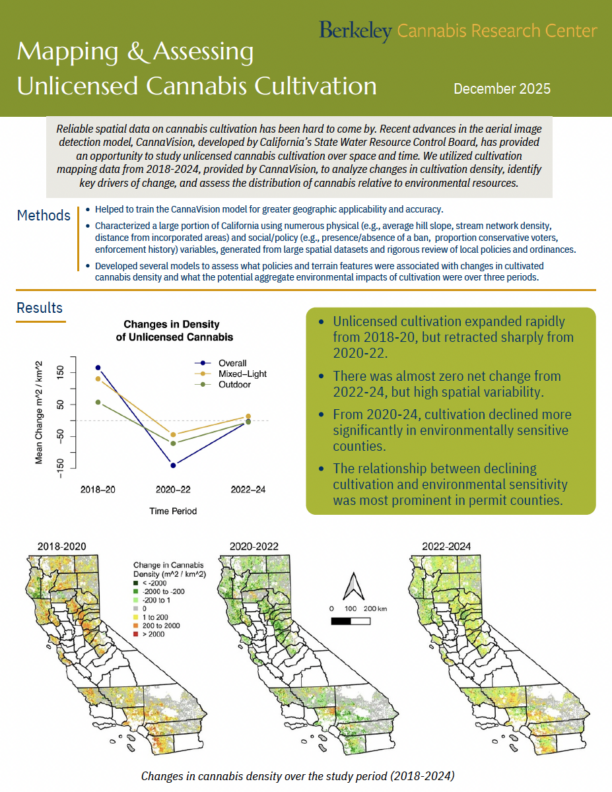
- Unlicensed cultivation expanded rapidly after legalization (2018-20) but has since receded to 2018 levels.
- Cultivation moved from hillier, remote areas into flatter areas (2018-20) and then back toward remote, hillier areas (2020-24).
- Participation in unlicensed cultivation was broad initially (2018-20) but has since become the domain of people in tenuous socio-economic situations.
- Unlicensed cultivation has migrated from public to private lands because of milder consequences.
- Unlicensed cultivators avoided fire-prone areas from 2018-2022 but have since moved back into these areas (2022-24).
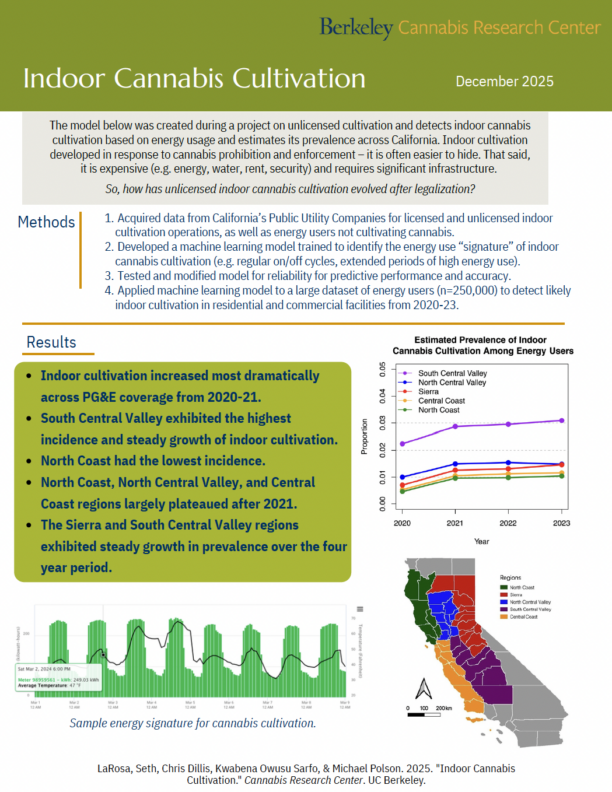
- There has been a consistent trend from outdoor to mixed-light cultivation.
- Unlicensed indoor cultivation has grown at a steadier rate than outdoor/mixed light since 2021.
- Presence of licensed cultivation in a given area was the most consistent deterrent of unlicensed production.
- Bans were not consistent or powerful indicators of unlicensed cultivation growth or decline.
- Perceived intensity of enforcement was an initial deterrent (2018-20) but this effect diminished (2020-22) and reversed (2022-24), becoming correlated with increasing unlicensed cultivation.
- Civil policies and enforcement (e.g. fines, landlord liability, hemp policies) became more efficacious over time.
- Troubles with permitting programs barred many would-be cultivators from licensure, thus ballooning participation in unlicensed cultivation.
- Bans, particularly when combined with a heavy enforcement reputation, created “whack-a-mole” movement of cultivation.
- Market forces (specifically wholesale price declines) drove unlicensed cultivators out of operation and into more remote landscapes.
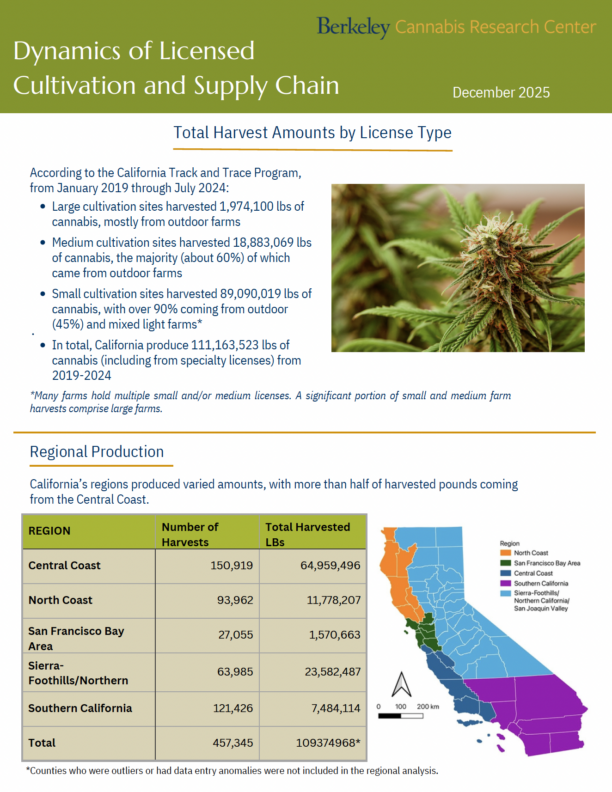
- Growth of licensed cultivation was more consistent than unlicensed cultivation.
- Licensed cultivation area increased more rapidly in new cultivation counties like Santa Barbara and decreased in legacy counties like Mendocino.
- Unlicensed cultivation is responsive to changes in presence of licensed farms.
Over time, environmentally sensitive counties, especially those with permit programs, saw reduced unlicensed cultivation relative to less sensitive counties.
Key Takeaways
- Promoting and maintaining a large network of licensed farms is the most effective way of deterring unlicensed cultivation.
- Permitting programs are more effective than bans (particularly intensively-enforced bans) in addressing environmental harms.
- Eradication-oriented enforcement has declining efficacy, specifically as persistent unlicensed cultivation winnows down to those with few other livelihood alternatives.
- Civil regulatory policies (e.g. fines, landlord liability rules) show efficacy over time.
- Unlicensed cultivation boomed (2018-20) busted (2020-22), and arrived at an equilibrium similar to 2018 levels (2022-24).
- Licensed and unlicensed cultivation are geographically diverging into remote, cheaper areas (unlicensed) and flatter, more proximate, less environmentally sensitive areas (licensed).
- Economic considerations (e.g. wholesale prices, barriers to licensure, alternative livelihood or land use possibilities) strongly mediate the extent and character of unlicensed cultivation.
- Cultivation has moved (2022-24) toward areas with bans, strong enforcement reputations, and conservative voters, likely because of economic and/or regulatory pressures.
- Integration of cannabis into regulatory and civic systems creates norms and fosters behaviors, even among unlicensed cultivators, that are socially and ecologically beneficial.
Policy Recommendations
Resources
Acknowledgements
This report and accompanying materials are the product of 30 months of work by Michael Polson (PI), Amanda Reiman (Co-PI), Chris Dillis, Joanna Hossack, Seth Larosa, Margiana Petersen-Rockney, Kwabena Owusu Sarfo, and Jeremy Sorgen. Thank you to Van Butsic for his work initiating and supporting this project.
We are deeply grateful to the individuals who generously shared their time, knowledge, experiences, and understanding with us. We also thank the representatives at the Department of Cannabis Control, METRC, the State Water Resources Control Board, PG&E, and SoCal Edison who responded to our requests and questions.
We also want to acknowledge the time and efforts of the University of California, Berkeley students, whose work as research assistants helped us further our analysis of the findings. Undergraduate research assistants spent countless hours conducting background research, writing, and working with GIS. The work of undergraduates greatly assisted us: Anhika Marie Bui, Cate Carlson, Rebekah Derris Murphy, Iroha Harada, Mia Hsu Puzzo, Emily Ma, Daniel Rodriguez, Alessandra Soberanes, McCree Tang, Martina Anne Arendain, Martina Arendain, Peri Zoe Yildirim-Stanley, Ryan Jen Wong, Alexa Marie Weiss, Hannah Welke, and Xiaoya Yuan, Audrey Theresa Shao, Hennessy Jones, Danicka G Sailer, Ellie Suh, Noah Alexander Menz, and Vincent Xuan Nghiem.
A special thank you to Pheng Lor for his administrative and organizational support.
Finally, we would like to recognize the institutional and administrative support provided by the Department of Environmental Science, Policy & Management at the University of California system and the Cannabis Research Center.
The University of California, Berkeley, submits this Final Report in fulfillment of contract #93284, “Licensed and Unlicensed Cultivation Across Ban and Permit Jurisdictions,” under the grant provided by the California Department of Cannabis Control.