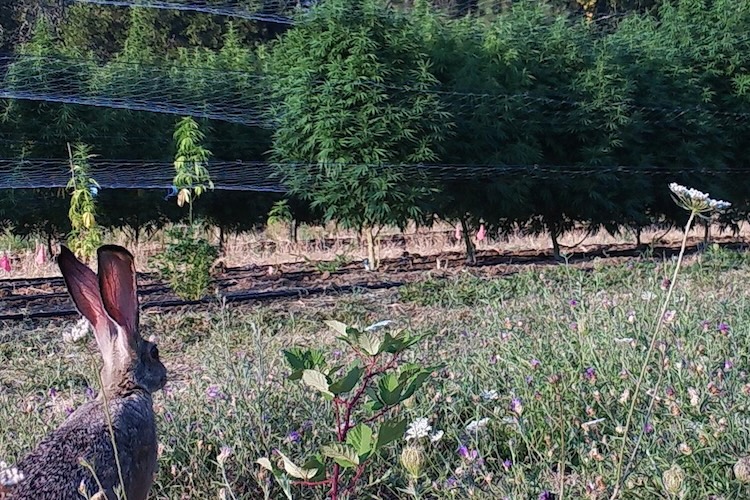
- Environmental impacts of cannabis production occur through the use of water, pesticides and energy, land cover change, and the pollution of air and water.
[button link=”https://crc.berkeley.edu/publication/cannabis-environmental-impacts/” class=”dmach-acf-value et_pb_button”]Wartenberg et al. 2021[/button]
- Since 2000, cannabis production rapidly expanded into undisturbed, sensitive habitat areas. Though farms tend to be small, they cause deforestation and contribute to wildlife habitat fragmentation.
[button link=”https://crc.berkeley.edu/publication/cannabis-agriculture-expansion-assessment-land-use-metrics/” class=”dmach-acf-value et_pb_button”]Wang et al. 2017[/button]
- Early regulations for medicinal marijuana did not prevent siting of cannabis farms in environmentally sensitive locations in northern California. The number of sites on steep slopes or near remote public lands both increased between 2000-2013.
[button link=”https://crc.berkeley.edu/publication/cannabis-agriculture-frontier-environmental-threat-policy/” class=”dmach-acf-value et_pb_button”]Butsic et al. 2018[/button]
- Seasonal water use by cannabis farms is influenced by water source. Farms that rely on surface water often divert and store water in the winter for irrigation, whereas farms that rely on groundwater divert water on-demand. [button link=”https://crc.berkeley.edu/publication/water-storage-and-irrigation-practices-for-cannabis-drive-seasonal-patterns-of-water-extraction-and-use-in-northern-california/” class=”dmach-acf-value et_pb_button”]Dillis et al. 2020[/button]
- Groundwater well use by cannabis farms is common and likely contributes to streamflow depletion. The majority of permitted cannabis farms use groundwater wells. Models suggest that unpermitted farms do the same, though extraction volumes vary substantially by watershed.
[button link=”https://crc.berkeley.edu/publication/water-use-cannabis-emerald-triangle-california-streams/” class=”dmach-acf-value et_pb_button”]Dillis et al. 2019[/button] [button link=”https://crc.berkeley.edu/publication/water-storage-and-irrigation-practices-for-cannabis-drive-seasonal-patterns-of-water-extraction-and-use-in-northern-california/” class=”dmach-acf-value et_pb_button”]Dillis et al. 2020[/button][button link=”https://crc.berkeley.edu/publication/water-demands-of-permitted-and-unpermitted-cannabis-cultivation-in-northern-california/” class=”dmach-acf-value et_pb_button”]Dillis et al. 2023[/button]
- Human activity on cannabis farms impact nearby wildlife communities. Wildlife observed on farms differs from surrounding uncultivated areas in southern Oregon, suggesting impacts on ecological communities.
[button link=”https://crc.berkeley.edu/publication/cannabis-farm-map/” class=”dmach-acf-value et_pb_button”]Parker-Shames et al. 2021[/button]